Desexing early – by 12 months old – not only has great health benefits for your dog but it will also ensure that you don’t run the risk of contributing to unplanned and unwanted dogs ending up being disposed of in council pounds and animal shelters.
Desexing:
- removes the risk of disease – such as mammary, uterine and ovarian cancer and pyometra (a life-threatening infection of the uterus) in females and prostate problems and testicular cancer in males.
- removes the risk of behavioural problems – such as aggression and urine marking in males. In females, it prevents mating behaviour and false pregnancy.
Studies have also shown that early desexing reduces other behavioural problems such as roaming, separation anxiety and inappropriate elimination when frightened.
Reducing the desire to roam also reduces the risk of your dog being injured in a fight or a traumatic accident such as being hit by a car. - research shows that desexed animals live longer.
- helps prevent abandoned dogs. The RSPCA receives over 125,000 animals every year, and many of these unwanted animals are the result of Irresponsible breeding.
You can read more about responsible/ethical breeding on this page: Ethical Breeding
When to desex ~ is there a ‘right’ time?
written by Dr Karen Davies – Veterinarian/Practice Manager – Direct Vet Services | Jun 20, 2023 | blog
Let me start by saying that there is no right or wrong answer, but there certainly are a few fairy tales out there and new information constantly coming to light. Curiously breed and size both play an important part in decision making as to the timing of desexing.
There are several considerations around development of medical and behavioural issues with regard to early desexing, desexing at around puberty, delayed desexing and leaving animals entire.
So, let’s have a look at them one at a time.
All of the facts below are based on credible peer reviewed studies with the most recent being published 07/07/2020 and not the personal opinions or observations of the general public, Facebook users or even mine.
Behaviour:
Separation anxiety, escaping and inappropriate elimination were all decreased in those male and female dogs desexed early (6w-12m). In a 15-month study where a sample of dogs were desexed at 7 weeks, 7 months and the remainder left intact investigated excitation, barking, playfulness, aggression towards other dogs, affection toward people and outgoing nature. The study concluded that there was no difference in the desexed groups, with an increase in barking and inter-dog aggression in intact individuals of both sexes. Interestingly, in dogs trained for disability service, those dogs desexed earlier had higher success rates indicating they may be better able to focus on training.
Musculoskeletal development:
The onset of puberty leads to closure of the growth plates. Contrary to popular opinion, desexing does NOT stunt the growth of an animal, in fact it prolongs it. Growth plates are present at each ends of the bones and are the area of the bone that allows it to grow during development. These areas stop becoming active with the onset of puberty and the development of sex hormones. Neutering means the animal does not develop those gonadal hormones and so the long bones grow slightly longer, in other words your dog will be slightly taller, if you desex early. There is now some evidence to suggest that there is a risk of developing some musculoskeletal problems with early desexing, such as long bone fractures, hip dysplasia, decreased muscle mass, or angular limb deformities, but this varies significantly between breeds. There has been ONE older study that concluded neutered animals in general were at greater risk of cruciate disease when compared to entire animals. I personally have noted that these animals tend to have longer straighter hind legs which could change the pressures on the knees and increase the risk of cruciate injury as it changes the angle of the top of the tibia (shin bone) and the direction of pressure on the joint. It is important to remember that Hip Dysplasia is a multifactorial condition, with multiple genes, environmental, dietary, exercise and body score (obesity) factors all contributing, so solely labelling early desexing as the cause would be irresponsible. with all of the studies investigators looked (after the fact) at the age at which the dogs were desexed and the occurrence of problems. Earlier studies look only at smaller often related breed groups.
Obesity:
Again, this is not a simple issue; genetics, diet and activity level all play a part. What might surprise you is that dogs that are desexed earlier are LESS likely to have obesity related issues – bet you didn’t see that one coming! Feeding your dog correctly with a diet well balanced in Protein, Fats and Carbs and getting out there and being active is the best way of avoiding weight related issues and not what age your dog is when it’s desexed. My belief is that puppies need to be vaccinated, neutered and played with lots, however too often owners get bored and just want their pet to sit next to them on the couch and not chew up their stuff… and then the waistlines of both parties grow!
Reproductive diseases and cancers:
Entire males are at risk of prostate cancer, prostatitis, prostatic abscesses, testicular cancers and anal adenomas/adenocarcinomas. Many of these conditions can turn out to be fatal and are often quite expensive to diagnose and to treat in the process.
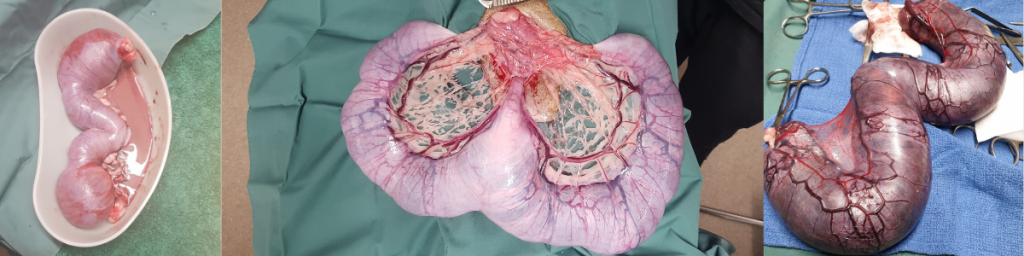
Entire females are at risk of breast cancer, uterine cancer, ovarian cancer, infected uterus (pyometra), phantom pregnancies and unwanted pregnancies. Pyometra involves a hormonal imbalance after a season leading to a uterus full of infection; this can happen with the first season or any one after that and can be fatal even after treatment due to the toxic effect that is has on the body. Don’t be surprised if you end up with a vet bill that could feed a small country – the amount of work behind the scenes that goes into trying to save one of these bitches is enormous, and although the surgery is often successful, the strain that the disease puts on the body occasionally leads to death in the days to weeks following.
Urinary Incontinence:
Both male and female dogs can suffer from hormonal incontinence. Age at desexing had no impact on males and as they age hormonal incontinence can occur in both desexed and intact males.
In females there was evidence in only one study that early desexing (less than 3 months of age) increases the risk of urinary incontinence. There is no scientific evidence to support the commonly held opinion that letting the bitch have one season had any impact on urinary incontinence, however it did significantly increase the risks associated with the surgical spey procedure itself. Spey should be delayed where the bitch has juvenile vaginitis, infantile vulva or if urinary incontinence is already present and your vet is best to advise on these conditions.
There is no benefit in letting your male “have one roll in the hay before he loses his manhood”, that’s your anatomy talking fellas. There is no benefit in letting any bitch that you are not planning on breeding with have a season in most cases (with a couple of exceptions I will mention shortly), as any hormonal exposure increases her cancer risk. Letting her have one litter can increase resource guarding and anxiety issues along with cancer risks.
Benefits:
Apart from all of the obvious ones mentioned above, there are a couple of benefits that are gained if your dog is desexed early.
smaller animal = less anaesthetic agents = greater drug safety
smaller tissues and less developed blood vessels = smaller wound and better recovery
less age, less hormonal experiences = less hormonal based behaviours
less drugs, quicker surgery, less complications = less expensive
A list will follow in the breeds investigated as part of the most recent study as to the most appropriate age for desexing. Other than for breeding, there is NO benefit in leaving your dog entire. There is however increased risk of disease, behavioural problems and injury (when they run amok chasing their next girlfriend, for example!). Did you know that more than 75% of cats hit by cars are entire males!
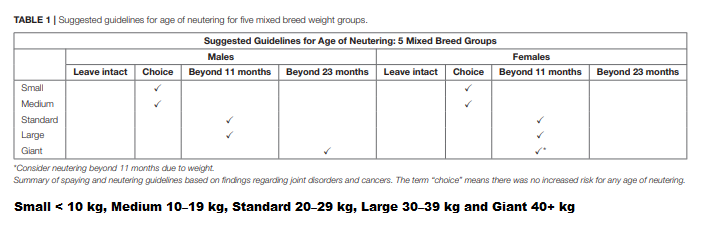
Image courtesy of: Frontiers | Assisting Decision-Making on Age of Neutering for Mixed Breed Dogs of Five Weight Categories: Associated Joint Disorders and Cancers (frontiersin.org)
Take a deep breath, be brave, uncross your legs as they are not your bits that the vet is removing (also makes it easier to drive) and pay a visit to your vet. Fellas if you really are desperate for your fella to keep the family jewels, then consider a hormone implant to chemically neuter them – it will last 12-18 months, and you can breathe a sigh of relief.
 Hill Top Family Pups